Sustainability is no longer a trend. What served as a differentiating argument in the last decade—almost as a conceptual luxury—has become a sine qua non condition of contemporary design.
This is not only because the market demands it and regulations are advancing, but because any design practice that ignores the Life Cycle Assessment (LCA) of what it produces is, by definition, operating with an incomplete vision. At Blaster Design, we integrate ecodesign not as an additional service layer, but as a cross-cutting methodological criterion.
Ecodesign is not a visual style: It is a technical methodology
One of the most deceptive practices in recent years is greenwashing: the strategy of attributing environmental characteristics to products or brands without a methodological foundation. The problem is not just ethical; it is structural.
Ecodesign requires traceability, technical criteria, and measurable decisions. Designing under this logic implies assuming that every choice—whether formal, functional, or technological—has systemic consequences. A well-executed project does not just respond to an immediate need; it optimizes its impact within the system in which it operates.
From designing objects to designing systems
For a long time, design focused on the classic triad: form, function, and technical viability. Today, that perspective is limited. No product or interface exists in isolation.
Adopting a systemic perspective involves understanding the dynamics that the object activates:
- Resources mobilized: Origin and carbon footprint.
- Promoted habits: Impact on user behavior.
- Externalities: Waste management and end-of-life.
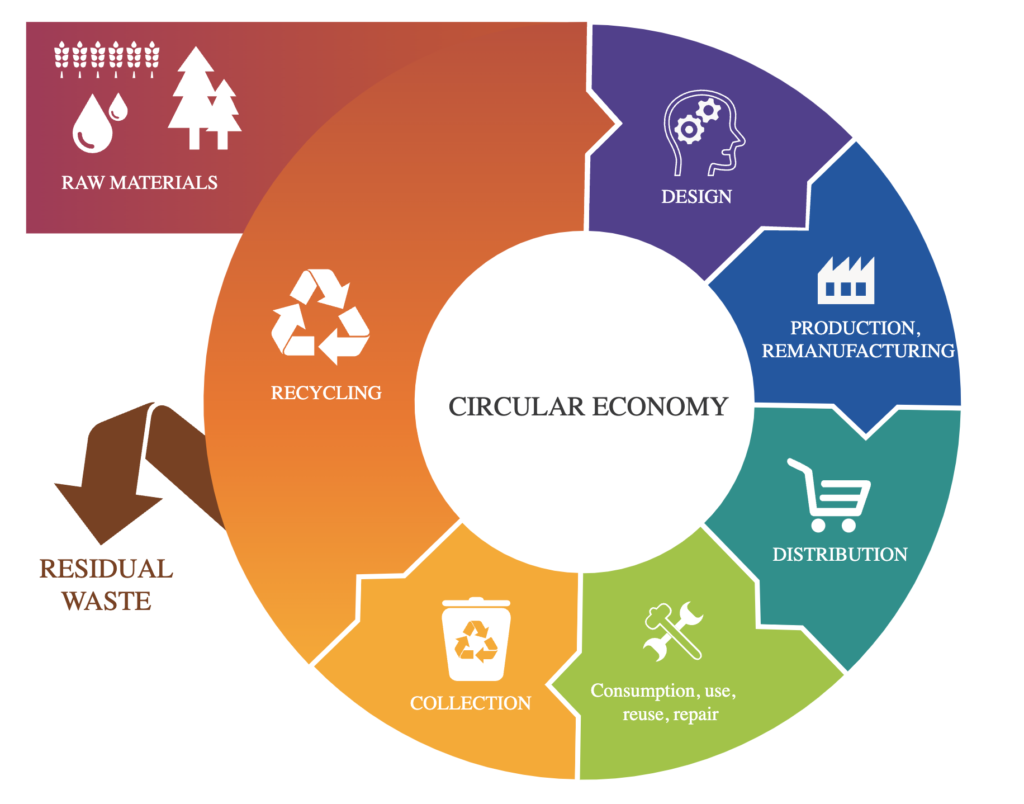
Circular Economy Model (Image source: ctitool.com, 2026).
How do we implement ecodesign in our projects?
At Blaster Design, sustainability is a non-negotiable value. This is how we translate these technical concepts into tangible solutions:
Interior Design and Sustainable Architecture
We operate under a Life Cycle Assessment logic. We consider material behavior over time, maintenance, and final disposal.
- Passive Strategies: We prioritize natural lighting and climate control before resorting to electromechanical systems.
- Design for Adaptability: In dense urban contexts like Medellín, we project spaces with functional adaptation capabilities, allowing changes in use without major structural interventions, which guarantees long-term economic profitability.
Industrial and Product Design
We articulate product development around four fundamental pillars:
- Selection of low-impact materials: Evaluation of provenance and processing.
- Manufacturing optimization: Energy efficiency during transformation.
- Extension of useful life: Physical and aesthetic durability.
- Design for end-of-life: A product that cannot be disassembled or reintegrated into a value stream is, technically, a poorly designed product.
UX/UI Design and Digital Ecodesign
The environmental dimension of software is critical. The technology sector is a major $CO_2$ emitter. We optimize:
- Code and Asset Efficiency: Reduction of computational load.
- Information Architecture: Direct navigation flows that minimize the energy consumption of the user’s device.
Why is ecodesign imperative today?
The Colombian market has matured. Local companies now compete under international standards where sustainability is an entry requirement. Today’s consumers base their decisions on the consistency of brand values.
Designing without considering the consequences is, quite simply, bad design. When sustainability is assumed as a transversal value, the questions change: the life cycle and the future evolution of the system are evaluated from the start.
In Blaster, this perspective is a core part of our methodology. If your organization is looking to elevate its design standards with a long-term vision, we are ready to accompany you. ¡Contact us!